
Transcending Operant Conditioning
How do I have a conversation with a horse, whilst maintaining pyschological and physical safety for us and others around us?
As I have evolved my relationship with horses since becoming a horse guardian in 2021, I have felt a desire to look beyond the structures and methodologies conventional animal training confines us to. One of the most predominant frameworks of conventional animal training is Operant Conditioning.
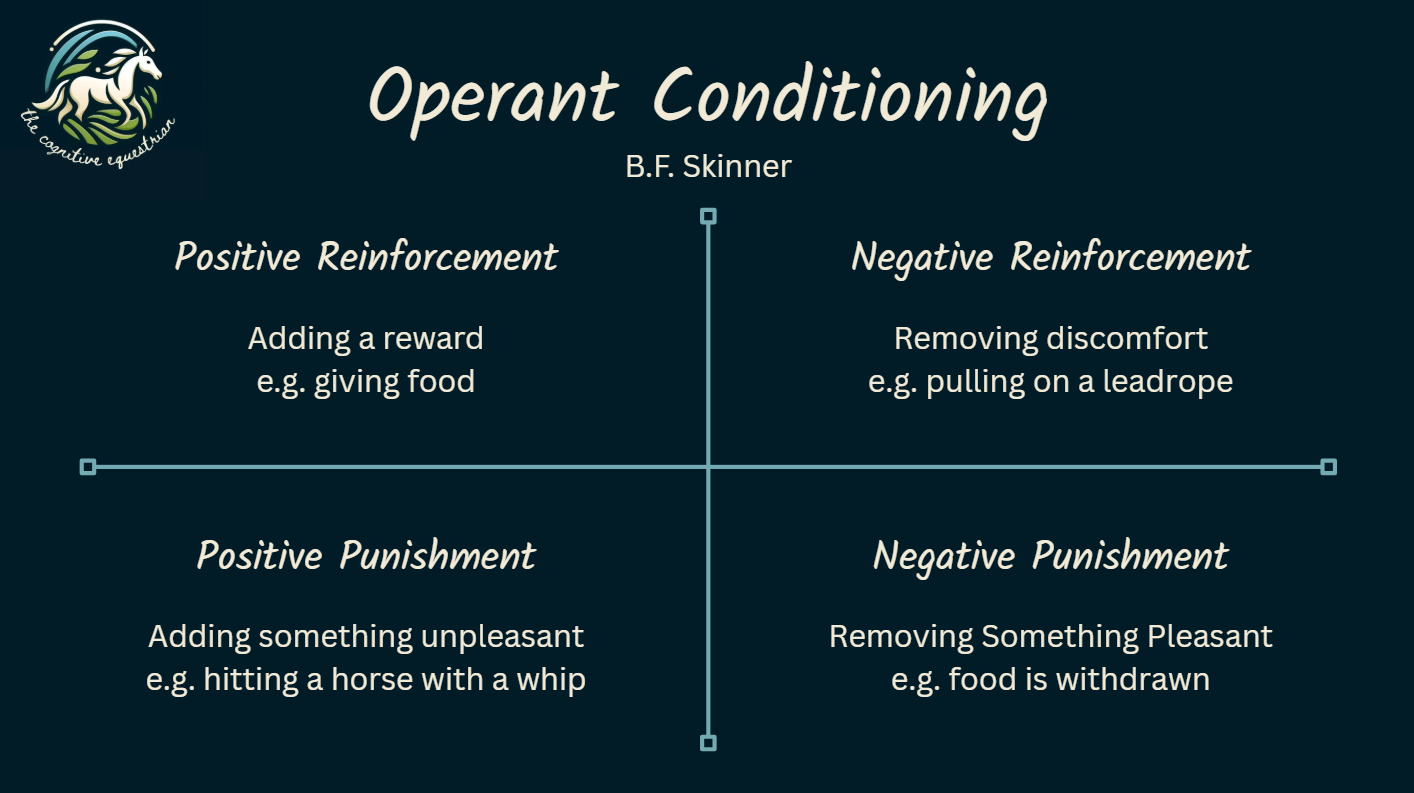
Whilst I started primarily in the Positive Reinforcement quadrant, I found that limiting in some circumstances with some horses. For my gelding Fion, I noticed if he created a movement and didn't get given food because perhaps it wasn't what I was asking, he would feel stressed and begin to show undesirable behaviours. But I found it difficult to have interactions with horses in any of the other quadrants.
So I found myself asking, where do I go now? How do I have a conversation with a horse, whilst maintaining pyschological and physical safety for us and others around us?
Inspired by Franceso De Giorgio and Jose De Giorgio-Schoorl's book Equus Lost: How We Misunderstand the Nature of the Horse-Human Relationship, I began exploring Transcending Operant Conditioning.
“To me and my horses, Transcending Operant Conditioning means moving beyond a sequential and structured approach to training, where focus is on movement execution. Instead relating to horses through emotional presence, nervous-system awareness and co-creation from a place of authenticity.”
While Operant Conditioning can be useful for teaching specific movements, it doesn’t account for the horse’s inner experience, such as their needs or current emotional capacity. If we are to truly meet the horse (and ourselves!) where we are at, in order to have a relationship-centered space that provides psychological safety, we must recognise that behaviour is communication.
We must hear what the horse is saying regarding “this is how it feels to be me right now” and exploring the underlying causes through longer term support, rather than 'quick fixes'. This approach honours the horse as a sentient being. It emphasises relationship and overall well-being, rather than performance. It requires the human to regulate themselves, listen deeply and adapt to each unique individual, creating a dynamic more like friendship with a healthy attachment than training.
Transcending Operant Conditioning: A Summary
Seeing behaviour as communication, not as something to suppress or 'fix'.
Supporting the underlying cause rather than manipulating the outward behaviour through dominance and confinement.
Allowing full emotional expression, not forcing a horse to be calm or suppressing 'undesirable' emotions such as fear, anxiety, etc.
Approaching the horse with neutrality where we are in a grounded, emotionally-balanced 'zero' state that allows for attunement and co-regulation.
Inter-species Problem Solving where humans lead horses into a space where they work together to find the answer.
Treating the horse as a relational partner rather than demanding an input–output from a place of expected transactionality.
Integrating co-creation and dialogue where both human and horse get to express their needs.
Recognising human responsibility, acknowledging that the horse’s well-being depends on the human’s state, decisions, and boundaries.
Using leadership as a shared, socially intelligent role that does not lie in a space of dominance or control.
Honouring individuality, since every horse (and human) needs a different balance of friendship, guidance, autonomy and support.
Working with the whole system including friendships, herd dynamics, attachment patterns and environmental context.